
MoE 3D Architecture Visualizer: Interactive 3D Visualization of Modern MoE LLM Architectures
Published:
Project Links:
- 🌐 Live Interactive Demo: https://yuntaozhang999.github.io/moe-3d-visualizer/
- 💻 GitHub Repository: https://github.com/yuntaozhang999/moe-3d-visualizer
- 📝 Technical Blog Post: Read the full post
The Challenge & Motivation:
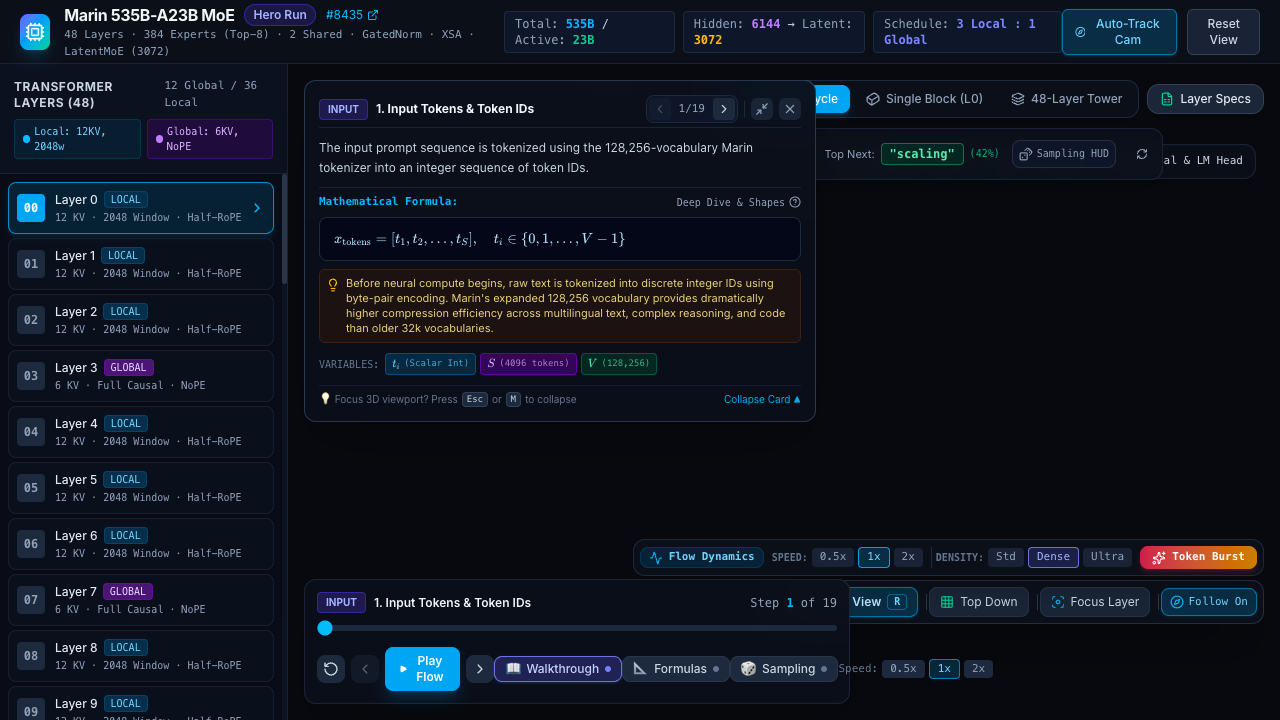
Most existing Transformer visualization tools focus on early dense models (such as GPT-2 or GPT-3) and lack interactive 3D exploration of modern 500B+ sparse Mixture-of-Experts (MoE) architectures. To understand the internal mechanics, tensor flows, and distributed hardware communication costs of modern MoE architectures (such as Marin 535B, LatentMoE, and GQA), I developed and open-sourced MoE 3D Architecture Visualizer.
Key Features:
- Client-Side WebGL Rendering: Runs entirely in the client browser with zero cloud server or GPU dependencies, built with React 18, Three.js / R3F, Tailwind CSS v4, and KaTeX.
- Multi-Scale 3-Level Observation:
- Macro View (48 Layers): 3D matrix overview displaying alternating local sliding-window and global causal layers.
- Quad-Cycle View (4 Layers): Flow of 3 local layers (2048 sliding window) and 1 global layer (4096 full causal) with residual pipelines.
- Micro-Block Focus (Single Layer): Deconstructs a single layer into 5 computation stages and 20+ operator nodes.
- Deep Mechanism & Hardware-Software Co-Design:
- LatentMoE Communication Compression: Compresses features from 6144-dim to 3072 latent space before cross-node All-to-All routing, reducing communication bandwidth by 50%.
- 384-Expert QB Routing: Visualizes Quantile-Balanced routing selecting Top-8 active experts alongside 2 shared full-width experts.
- Cutting-Edge Attention Operators: Grouped-Query Attention (GQA 4:1 / 8:1), ShortConv causal depthwise convolution, XSA orthogonal decorrelation, and input-dependent head gating.
- Interactive Perception Highlights:
- Step 19 Dynamic Sampling Pipeline: Real-time probability recalculation, temperature slider (0.1–2.0), Top-k/Top-p truncation, and Monte Carlo roulette animation with token append.
- 96-Dimensional Tensor Canvas Microscope: Bipolar amplitude waveforms, dense sign strips, RMS statistics, and crosshair probe HUD.
Technologies Used:
React 18, TypeScript, Three.js, @react-three/fiber, @react-three/drei, Tailwind CSS v4, KaTeX, Vite 8, GitHub Actions, GitHub Pages, MIT License