
Tracking Grad Norm Surge and Unbounded Final Norm
Published:
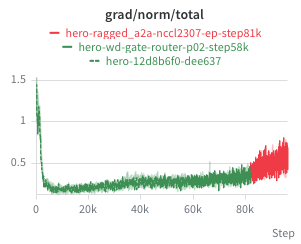
Recently, we observed a significant surge in grad/norm/total immediately following the step 81k swap to a near-dropless Expert Parallelism (EP) routing strategy. As seen in the red line of our metrics dashboard, the total gradient norm suddenly spiked:
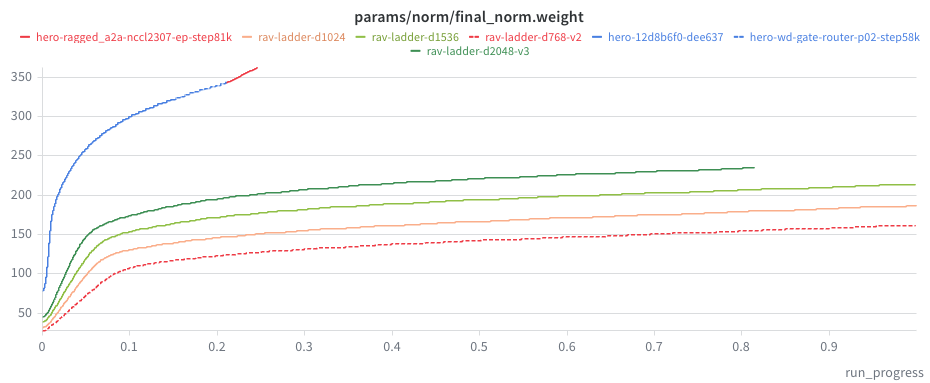
However, an important correction must be made regarding the root cause. The norm of final_norm.weight had already reached approximately 340 well before step 81k (as shown by the blue line). The switch to near-dropless EP at step 81k did not initiate this growth from 78; rather, it caused the slope to steepen further, driving the norm past 360+:
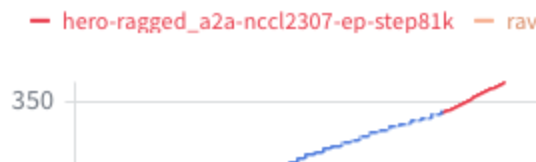
A zoomed-in perspective at the step 81k transition boundary highlights this slope steepening clearly:
Domination by lm_head
The total gradient norm is heavily dominated by the lm_head, which contains around 800M parameters. Since the lm_head is directly facing the cross-entropy loss, any changes to the incoming activations directly impact its gradients. The term “incoming activation” refers exactly to the features being fed into the lm_head from the final layer of the transformer block.
RMSNorm Learnable Parameter
To understand the amplification, we need to look at RMSNorm. The learnable parameter, gamma, is a 6144-dimensional vector, not a single scalar. When initialized to ones, its L2 norm is approximately $\sqrt{6144} \approx 78.4$.
Excluded Weight Decay
Why did the norm of final_norm.weight grow unbounded to 340+? In the Marin model, weight decay is applied to gates and routers, but it is explicitly excluded on final_norm (norm weights have wd=0).
Gradient Amplification
Because the final norm’s weight has grown to ~340, it amplifies the gradient significantly. The incoming feature $z$ to the lm_head is computed as $z = (x / \text{rms}(x)) \times \gamma$. With the norm of $\gamma$ increasing from ~78 to ~340+, the feature magnitude is amplified by roughly 4.6x. This directly scales the gradient with respect to the lm_head weights ($dL/dW_{lm}$).
Safeguards and Contingency
We currently employ a Logit z-loss of 0.0001 as a safeguard. However, as a contingency plan, if the gradient norm reaches a dangerous threshold of 5+, we may need to introduce weight decay to the final_norm parameter to constrain its unbounded growth.
Leave a Comment